A sample can fit correctly when it leaves the factory and still become too short after the first wash. The body length may change, the sleeves may pull up, or the side seams may no longer hang as they did during fitting.
When this happens, it is easy to treat the problem as a garment measurement issue. Sometimes it is. But the cause may have started much earlier, before the fabric was approved and released for cutting.
A fabric shrinkage test measures how a material changes after a specified treatment, usually washing and drying. The result is commonly expressed as a percentage in the length and width directions. For a clothing brand, however, that percentage is only the starting point.
The real questions are how the fabric was tested, whether the specimen represents bulk production, and how the result should affect the pattern, sample, and cutting decision.
An approved size specification cannot prevent fabric from changing later. A garment may meet its target measurements before washing and fall outside the intended fit after washing. A fabric may also extend in one direction instead of contracting.
Shrinkage testing is therefore more than a laboratory exercise. It helps determine whether a fabric is ready for production and what still needs to be adjusted or verified before bulk cutting begins.
A Shrinkage Result Means Little Without the Test Conditions
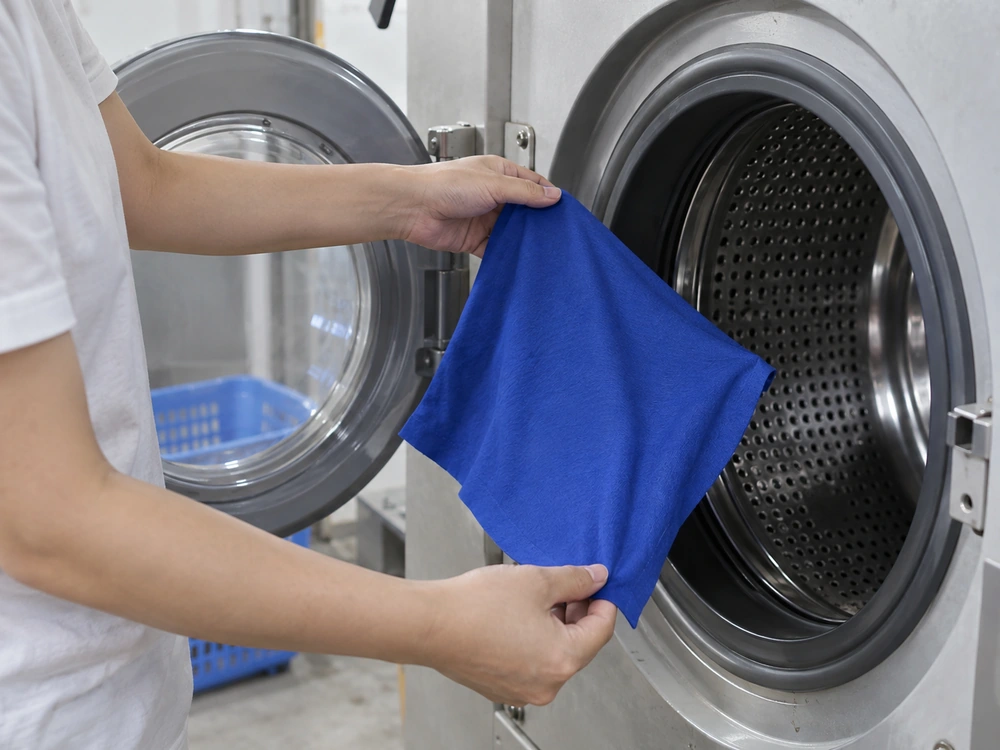
A report that says “3% shrinkage” may look clear, but it leaves out much of the information needed to evaluate the result.
Was the fabric machine washed or hand washed? Was it tumble dried, line dried, or dried flat? How many cycles were completed? Were those conditions selected to reflect the care method intended for the finished garment?
Change the conditions and the result may also change.
Two suppliers can test similar fabrics and report different percentages without either calculation necessarily being wrong. They may have used different temperatures, machine settings, drying procedures, cycle counts, conditioning periods, or measurement methods.
Before comparing the numbers, a brand needs to understand how they were produced.
Match the Test to the Intended Product
A cotton T-shirt expected to be machine washed and tumble dried may need a different evaluation from a garment intended to be washed gently and dried flat. A garment-washed product also follows a different production path from a garment sewn from finished fabric and shipped without further wet processing.
Some buyers provide their own test method, care conditions, acceptance limits, or laboratory requirements. When those requirements exist, the factory should follow them rather than substitute a convenient internal wash test.
If the buyer has not specified a method, the brand and manufacturer still need to agree on conditions that make sense for the product. The test procedure, number of cycles, drying method, and acceptance requirement should be clear before the result is used for approval.
There is no single shrinkage percentage that is automatically acceptable for every fabric or garment. The decision depends on the material, product type, intended fit, care conditions, buyer specification, and how the result will be managed during development.
Know What Kind of Test Was Performed
During fabric sourcing or early sampling, a factory may run an internal wash trial to identify an obvious dimensional stability problem. This can be useful when comparing materials or deciding whether sampling should continue.
An internal development test is not automatically the same as a formal laboratory test.
Recognized methods control specimen preparation, marking, laundering, drying, conditioning, measurement, and calculation. A development wash trial may answer a narrower production question and should be identified honestly.
AATCC TM135 is used to determine dimensional changes in fabrics after home laundering, while AATCC TM150 applies to garments. Within the ISO system, ISO 3759 covers preparation, marking, and measurement; ISO 6330 specifies domestic washing and drying procedures for textile testing; and ISO 5077 covers the determination of dimensional change.
These methods are related, but their names are not interchangeable. They also do not mean every order must use every standard. The correct method depends on the test object, buyer requirement, intended care conditions, and purpose of the test.
If a buyer requests an ASTM test, the exact designation and scope should be confirmed. “ASTM shrinkage test” alone does not identify one universal method for all fabrics.
How a Fabric Shrinkage Test Is Performed and Calculated
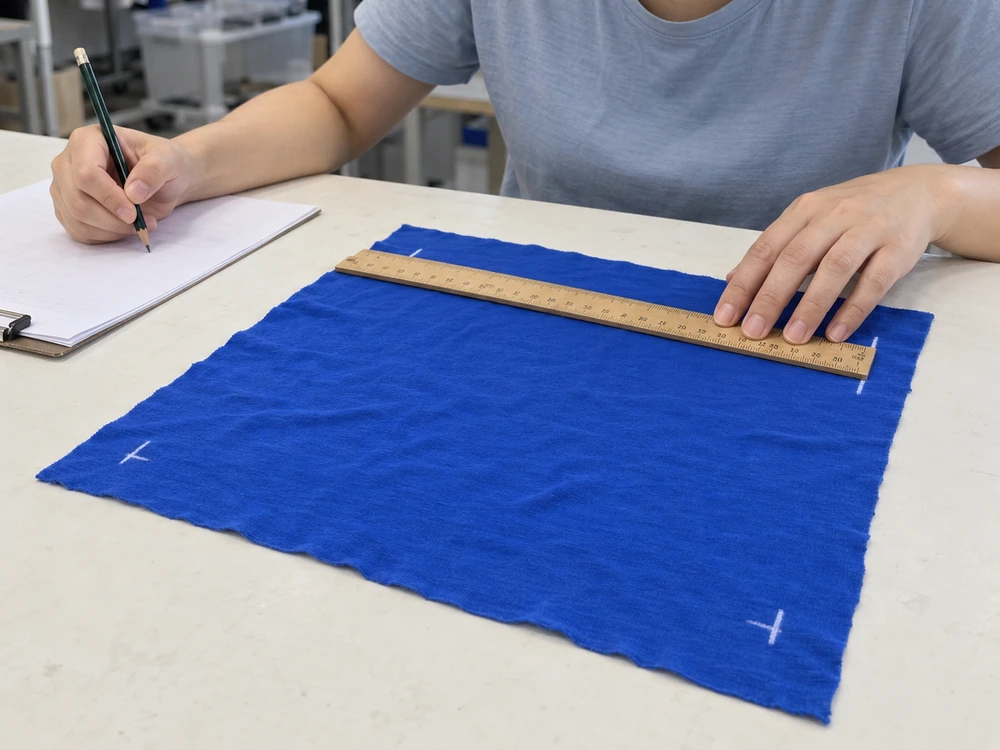
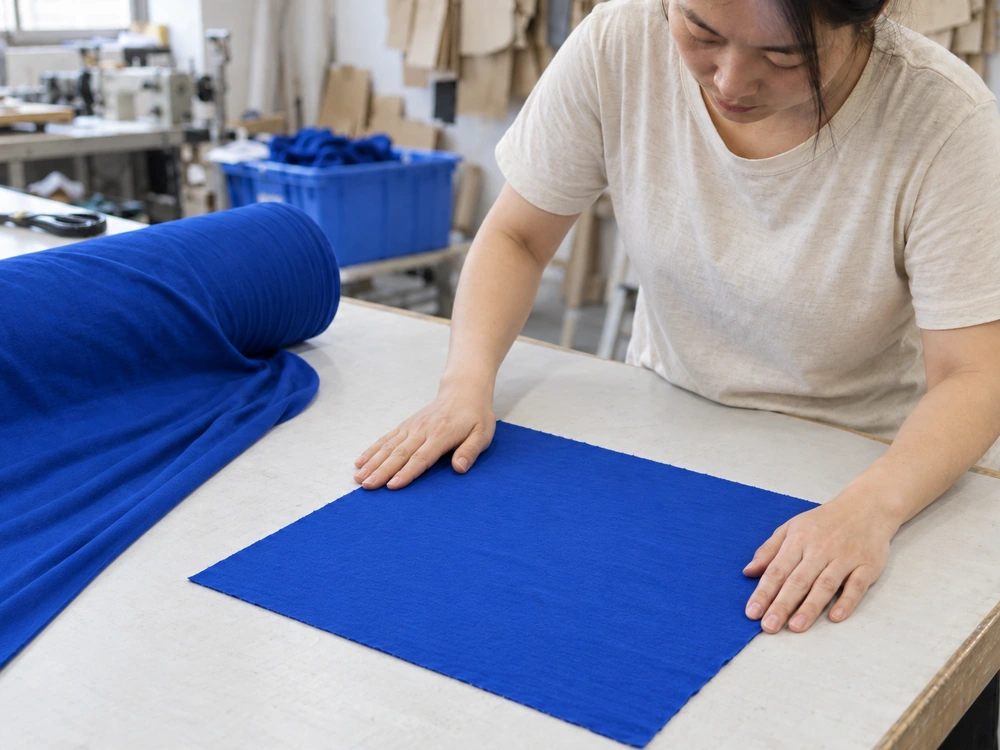
The basic process is straightforward: measure the fabric, expose it to an agreed treatment, and measure it again.
The challenge is keeping the procedure controlled enough for the result to support a production decision.
Start With Representative Material
The specimen should represent the material being evaluated as closely as possible. Its construction, fiber content, color, lot, and finishing condition should be identifiable.
This becomes especially important when moving from development into bulk production. A test performed on sample yardage can support an early fabric or pattern decision, but it does not automatically describe the behavior of a later bulk lot.
The specimen size and marking arrangement depend on the selected method. There is no need to present one sample size as the universal rule for every factory, buyer, and testing standard.
Before measurement, the fabric may need to be conditioned or allowed to settle according to the procedure being followed. It should not be stretched flat simply to make the marks easier to measure.
Measure Length and Width Separately
Fabric does not always change equally in both directions.
For woven fabrics, reports may refer to the warp and weft directions. For knitted fabrics and general production communication, teams may use length and width. Whichever terminology is selected, the directions should be clearly identified and calculated separately.
Multiple measurement pairs may be marked within the specimen as required by the test method. This reduces the influence of one inaccurate mark or a localized irregularity.
The original distances are recorded before treatment. The specimen is then washed and dried using the agreed conditions, which may include:
- Washing procedure and temperature
- Detergent
- Machine type or cycle
- Number of cycles
- Drying method
- Additional treatment required by the product
After treatment, the fabric is prepared for measurement according to the selected method. It should lie naturally without being pulled back to its original dimensions.
The same marked points are then measured again.
Calculate the Percentage
A common way to express contraction is:
Shrinkage percentage = (Original measurement − Final measurement) ÷ Original measurement × 100
Suppose the marked length was 500 mm before washing and 485 mm after washing:
(500 − 485) ÷ 500 × 100 = 3% shrinkage
If the original width was 500 mm and the final width was 492 mm:
(500 − 492) ÷ 500 × 100 = 1.6% shrinkage
The results would be recorded separately:
- Length shrinkage: 3%
- Width shrinkage: 1.6%
These figures demonstrate the calculation only. They do not define an industry-wide acceptance standard.
Reports may also use different sign conventions. Some records show contraction as a positive shrinkage percentage. Others report signed dimensional change, where contraction may appear as a negative value and extension as a positive value.
The formula and sign convention should therefore be checked before results from different suppliers or laboratories are compared.
Look Beyond the Average
A single overall number can hide the direction that matters most to the garment.
If a fabric changes very little in width but contracts noticeably in length, body length and sleeve length may face a greater risk than chest width. Combining both directions into one average would hide that difference.
The test should also record visible changes that a percentage cannot fully describe, including skewing, bowing, uneven distortion, edge curling, or a noticeable change in surface appearance.
A fabric may produce an acceptable-looking average while still causing problems if the change is uneven or the structure becomes distorted.
Fabric Relaxation and Wash Shrinkage Are Different Checks
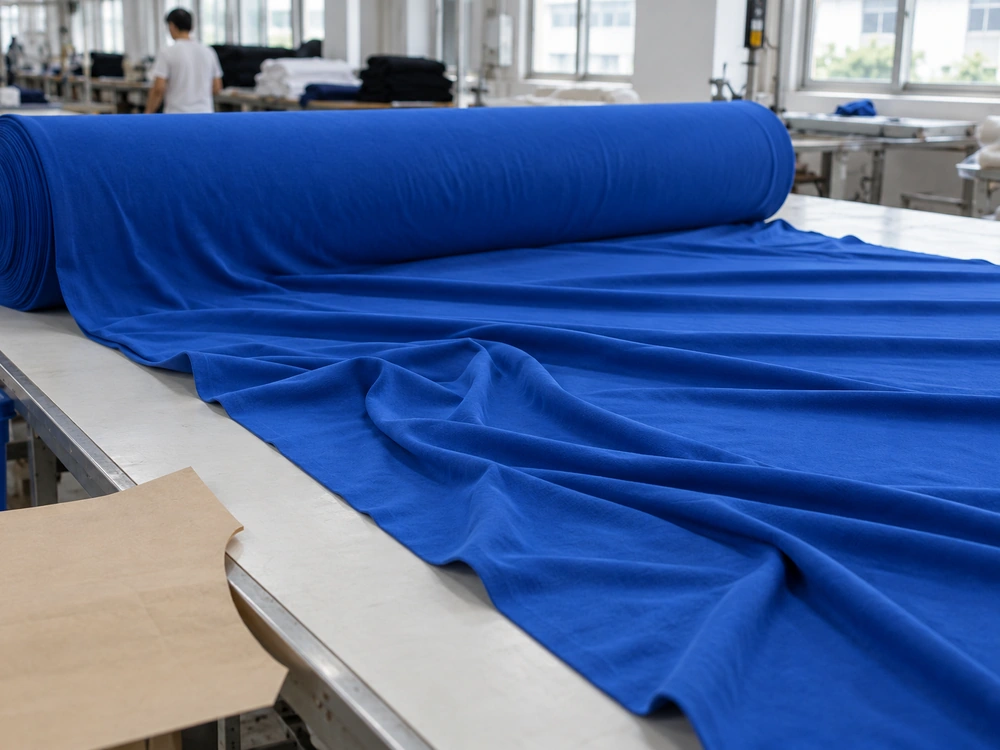
Fabric can carry tension from knitting, weaving, dyeing, finishing, rolling, and transportation. When a roll is opened and spread, some of that tension may begin to release.
Relaxation allows the material to settle before cutting. It helps reduce the risk of cutting fabric while it is still being held in an unstable, stretched condition.
There is no single relaxation time for every material. A tightly rolled knit, a stable woven fabric, and a fabric containing elastane may require different handling. The factory may consider the construction, roll condition, finishing process, storage environment, and cutting procedure.
Relaxation does not replace a wash shrinkage test.
Relaxation evaluates how the material settles before cutting. A wash test evaluates dimensional change after a specified washing and drying treatment. A fabric can appear stable on the cutting table and still contract after laundering.
Both checks may be necessary, but they solve different production problems.
How the Result Affects the Pattern and Sample
A shrinkage percentage is an input for the patternmaker, not a direct instruction to enlarge every pattern piece by the same amount.
Length and width may behave differently. Pattern pieces may also follow different grain directions, while the garment may combine main fabric with rib, elastic, lining, binding, or other materials that react differently during treatment.
Construction matters too. Necklines, cuffs, waistbands, hems, seams, and panel joins can restrict or redistribute dimensional change. The percentage measured on a flat fabric specimen will not necessarily appear at every finished garment measurement point in the same way.
Pattern compensation should therefore consider:
- Length and width results
- Grain direction
- Garment silhouette and intended fit
- Fabric stretch and recovery
- Rib, elastic, lining, and other components
- Seam and construction details
- Washing or finishing after sewing
- Required measurements before and after care
Pattern compensation is not the same as seam allowance. Seam allowance provides fabric outside the stitching line for construction. Increasing it does not correct a dimensional stability problem.
Not every shrinkage result should be solved through the pattern either. If the change is excessive, inconsistent, or accompanied by distortion, enlarging the pattern may only hide a problem with finishing, compaction, heat setting, lot consistency, or the test procedure.
Depending on the project, the better response may be to improve the fabric finishing, retest the material, compare another lot, select a more suitable fabric, adjust selected pattern dimensions, or make another wash-test sample.
Any adjustment should be validated on a representative garment. The sample should be measured before treatment, processed under the agreed conditions, and measured again.
Fit and appearance still need to be checked. A washed sample may meet several main measurements while showing twisted side seams, a distorted neckline, puckering, uneven panels, or a different overall silhouette.
The production decision is not simply to test the fabric and enlarge the pattern. It is to understand the result, choose an appropriate response, and verify that response before bulk cutting.
Why Sample Fabric May Not Represent Bulk Production
A development sample and the bulk garments may not use material from the same lot.
The sample could be made from available yardage while the final fabric is knitted, dyed, compacted, heat-set, or finished later. Even when the specification appears unchanged, differences in processing can affect dimensional stability.
Different colors may also behave differently. A result from one color should not automatically be treated as proof that every bulk color will respond identically.
When bulk fabric arrives, the factory should confirm whether the tested material represents the actual production lot. Retesting requirements depend on the buyer, fabric, order, and level of risk, but the earlier sample report should not be accepted blindly.
Garment-Washed Styles Need Another Level of Validation
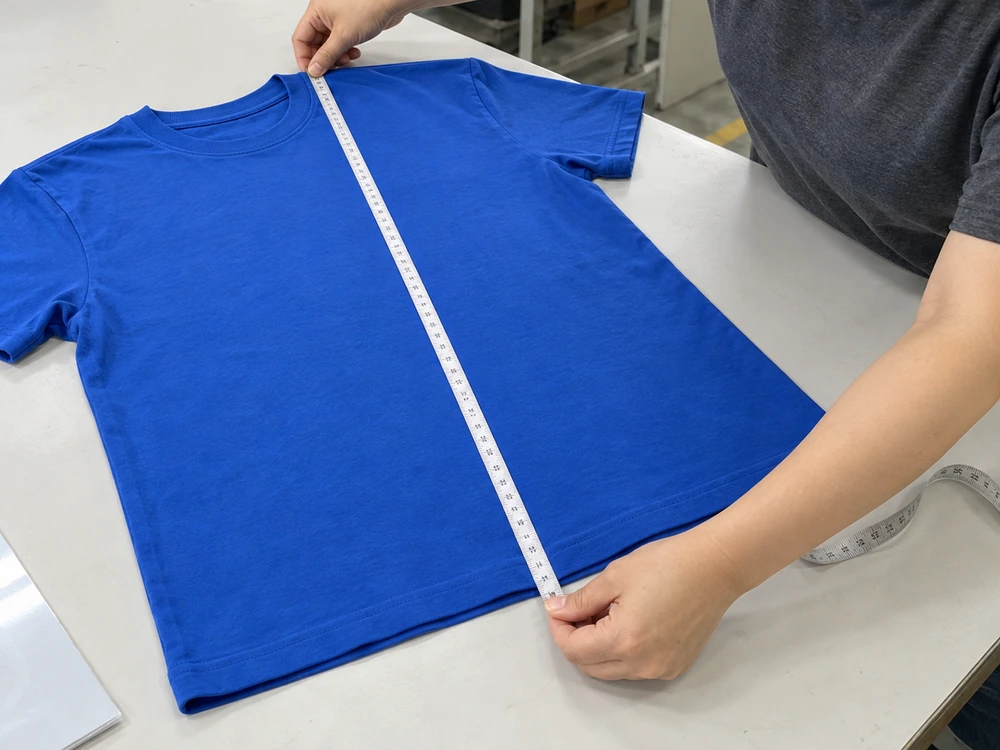
Vintage washes, garment dyeing, enzyme washes, acid washes, and other post-sewing treatments introduce additional dimensional change after the garment has already been assembled.
A fabric-only test may not predict the complete result.
The main fabric, rib, sewing thread, elastic, and trims can respond differently during garment processing. Panel position, load size, treatment time, mechanical action, drying, and finishing may also affect the final measurements and appearance.
These products may require both fabric-stage evaluation and a finished garment wash trial. The approved washed sample should be checked for measurements, fit, shape, construction, color, and surface effect before the process is released for bulk production.
What to Confirm Before Fabric Is Released for Cutting
Before bulk cutting, the brand and manufacturer should be able to answer a few practical questions:
- Was the actual production fabric or a clearly identified representative lot tested?
- What washing, drying, and cycle conditions were used?
- Were length and width recorded separately?
- Did the fabric show distortion as well as dimensional change?
- Which buyer or project requirement is being applied?
- Does the pattern need adjustment?
- Was the decision validated on a washed garment sample?
- Is the fabric formally approved for cutting?
A report that only states one percentage cannot answer all of these questions.
For clothing brands, the value of a fabric shrinkage test lies in what happens after the measurement. The result should lead to a clear action: approve the material, investigate a problem, adjust development, make another sample, or stop the fabric from entering the cutting room.
If you are preparing a custom clothing style and are unsure whether the available fabric information is enough for sampling or bulk production, send YX Custom Clothing your product details, intended care method, fabric reference, and any existing test report. We can review what still needs to be confirmed before production moves forward.