A sample can measure exactly to spec and still develop sizing problems once the same style moves into bulk production.
The pattern is only one part of the result. Fabric relaxation, cutting, sewing, pressing, washing, and even the way a garment is placed on the measurement table can affect the final measurement.
For that reason, garment measurement tolerance is more than a number added beside a size spec. It only works when the brand and manufacturer are clear about three things: the target measurement, the measurement method, and the acceptable variation around that target.
If one of those is unclear, a measurement sheet can look complete and still cause problems later in production.
What Measurement Tolerance Actually Controls
A garment specification normally gives a target measurement for each point of measurement, commonly referred to as a POM.
For example, an individual tech pack might specify:
| Point of Measurement | Target | Tolerance |
|---|---|---|
| Half chest | 60 cm | ±1 cm |
| Body length | 72 cm | ±1 cm |
| Sleeve length | 24 cm | ±0.7 cm |
These numbers are only an example, not a universal tolerance standard.
If the half chest is specified at 60 cm with an agreed tolerance of ±1 cm, a finished garment measuring between 59 cm and 61 cm would fall within that stated range, provided it has been measured using the agreed method and in the correct condition.
The target, however, is still 60 cm.
Tolerance defines an acceptable production range around the target. It does not replace the target.
That distinction becomes more useful when several garments are reviewed together.
One garment at 60.8 cm may not mean much. If ten consecutive garments all finish between 60.7 and 60.9 cm, they may still be within tolerance, but the production is clearly sitting close to one side of the approved range.
That does not automatically make the garments defective. It does give the production team a reason to check whether the process is consistently moving away from the target.
Target measurement, grade rule, and tolerance are different
These terms are sometimes mixed together when a specification has gone through several revisions.
The target measurement is the intended finished measurement for a particular size.
The grade rule controls how that measurement changes between sizes.
The tolerance defines the permitted variation around the target for the finished garment.
If a size M chest is 56 cm and size L is 60 cm, the 4 cm change belongs to the grading.
It is not a tolerance.
If the size progression is wrong, increasing the tolerance does not correct it. The pattern or grade rule needs to be reviewed.
A Tolerance Number Is Not Enough Without a Measurement Method

A surprising number of measurement disagreements start with the method rather than the garment.
Two people can measure the same piece and get slightly different results.
One person may smooth the fabric flat. Another may leave it completely relaxed. Sleeve length may be taken from a different point at the shoulder seam. Stretch fabric may change depending on how much tension is applied while the garment is positioned.
The same issue can appear around:
- neck openings,
- rib collars,
- elastic waistbands,
- armholes,
- curved seams,
- dropped shoulders,
- and washed garments.
For important POMs, the specification should make the method clear enough that both sides can reproduce the measurement.
Depending on the garment, that may include:
- where the measurement starts and ends,
- how the garment is positioned,
- whether the fabric should be relaxed,
- whether an elastic area is measured relaxed or extended,
- whether the garment is measured before or after washing,
- and any special handling required for that POM.
Diagrams are particularly useful where a point can reasonably be interpreted in more than one way.
Simply tightening a tolerance will not solve an unclear measurement method. It can make the disagreement worse because both sides are comparing measurements taken under different conditions.
The Same Tolerance Should Not Automatically Be Used for Every POM
There is no single tolerance table that is automatically correct for every garment.
That does not mean tolerances are arbitrary.
They need to make sense for the garment, fabric, construction, measurement point, and the buyer’s requirements.
A large body measurement does not behave the same way as a small functional opening.
On an oversized T-shirt, a small change across the chest may have relatively little effect on the intended appearance. The same amount of variation at a neckline, narrow waistband, cuff, or pocket placement may be much more noticeable.
Fabric behavior also changes what is realistic.
A rigid woven fabric behaves differently from cotton jersey. Rib behaves differently from the main body of a sweatshirt. A stretch fabric introduces different variables from a stable non-stretch fabric.
Garment washing adds another layer.
When tolerances are being set or reviewed, relevant factors can include:
- garment type,
- fabric construction,
- stretch and recovery,
- sewing construction,
- wash or dye process,
- the length and location of the POM,
- and the customer’s quality requirements.
Some brands already have established measurement manuals and tolerance standards. In those cases, the factory should work to the approved specification unless changes are formally agreed.
Where tolerances have not yet been defined, they should be discussed during development and sampling rather than left for the QC team to interpret after bulk garments are finished.
Sample Approval Is Where Measurement Control Should Become Clear

A sample should not be approved only because every measurement falls inside tolerance.
Fit and measurement direction still matter.
Suppose the target chest is 60 cm and the agreed tolerance is ±1 cm.
The sample measures 60.9 cm.
It may technically fall within the stated range.
If the fit is correct and the brand approves it, there may be nothing to correct.
But if the intended fit is closer to the 60 cm target, or repeated samples keep finishing around 60.8–61 cm, the reason is worth checking before bulk production begins.
The difference might be coming from:
- the pattern,
- seam allowance,
- sewing handling,
- pressing,
- fabric relaxation,
- or the measurement method itself.
Tolerance is intended to accommodate reasonable production variation.
It should not be used to avoid correcting a known pattern or process issue simply because the current result has not yet moved outside the permitted range.
By the time the sample is approved, the final tech pack, size specification, POM definitions, tolerances, and sample comments should all reflect the same approved version.
This sounds basic, but version control causes real production problems.
A sample may be corrected during fitting, while an old measurement remains in the tech pack. Or a revised comment may exist only in an email and never make it into the final specification.
In those situations, the production issue is not really tolerance. The factory may simply be working from the wrong information.
Where Measurements Begin to Move in Bulk Production

A garment rarely becomes out of tolerance for the first time at final inspection.
The variation normally enters earlier in the process.
Fabric and cutting
Knitted fabrics can change after relaxation. If cutting begins before the fabric reaches a stable condition, panel measurements may change afterward.
Cutting accuracy also affects the finished garment.
Layer movement, inaccurate panel placement, or inconsistent handling can later show up as differences in body width, garment length, or matching points.
Sewing
Sewing introduces its own variation.
Seam allowance, feed, tension, operator handling, and the way different components are joined can all affect the final measurement.
Areas that often deserve closer attention include:
- shoulders,
- armholes,
- necklines,
- waistbands,
- cuffs,
- plackets,
- and curved seams.
A small difference at one operation may have very little impact. Several small differences through multiple operations can become visible in the finished measurement.
Washing, pressing, and finishing
The condition of the garment when it is measured also matters.
A piece measured immediately after pressing may not give exactly the same result once it has relaxed.
Washed products can introduce greater variation.
Cotton jersey, fleece, rib, and fabrics containing elastane can respond differently to washing and drying. Garment dye, vintage wash treatments,, enzyme wash, and similar finishing processes can also affect final dimensions.
For these styles, the measurement condition needs to be clear.
If the approved finished specification applies after washing, measuring some pieces before wash and others after wash will obviously produce unreliable comparisons.
Where expected shrinkage needs to be compensated for, that should be considered during development and before bulk cutting rather than discovered after the wash process.
How to Read Measurement Results During Production
Measurement control is most useful when it catches a trend early.
Before production begins, the factory should have one current reference: the approved sample, current measurement specification, tolerances, and any relevant diagrams or comments.
The first bulk pieces are particularly useful because they show what happens when the approved pattern moves from sample development into line production.
If several first pieces are already sitting close to one tolerance limit, there is still time to investigate.
Inline measurement works in much the same way.
The purpose is not always to fully measure every garment at every stage. The more useful question is whether the checks are frequent and relevant enough to identify a repeated change before it becomes a larger problem.
Consider two groups of measurements for a 60 cm target.
Group A
59.6 / 60.3 / 60.0 / 60.4 / 59.8 cm
These results move around the target.
Group B
60.7 / 60.8 / 60.8 / 60.9 / 60.8 cm
If the approved tolerance is ±1 cm, both groups may still fall inside the allowed range.
But the second group tells you something different about the process.
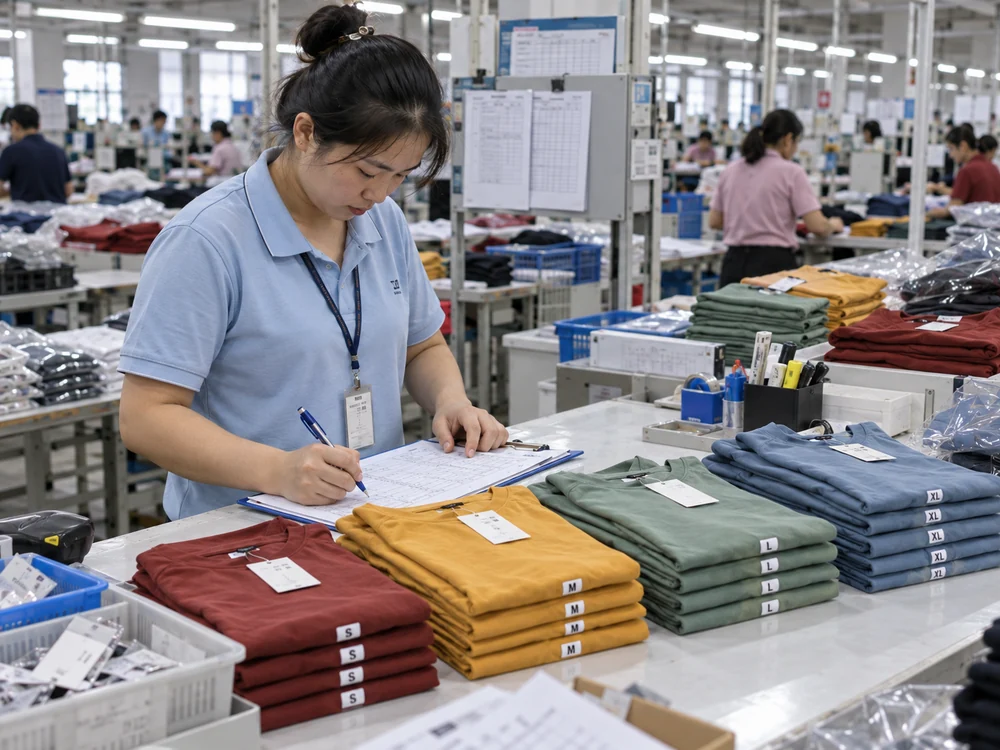
Production is consistently running toward the upper side.
That still does not mean the garments automatically fail inspection. It means there is a visible direction in the measurements, and it may be worth finding out why before later pieces cross the limit.
This is where inline QC adds value.
It gives the production team a chance to correct a developing issue while garments are still being made rather than simply recording it after packing.
When a Measurement Is Out of Tolerance
An out-of-tolerance reading should first be confirmed before deciding where the problem came from.
Check the basics:
- Is the correct size specification being used?
- Is the correct POM being measured?
- Is the garment positioned correctly?
- Is the agreed measurement method being followed?
- Is the garment in the required finished condition?
- Does the same result repeat across other pieces?
If a measurement repeatedly falls outside tolerance, the next step is to trace where the variation is entering the process.
The likely cause depends on the garment.
A body-width problem may involve pattern, cutting, or sewing.
A finished-length problem may involve fabric relaxation, cutting, washing, pressing, or a combination of these.
A waistband issue may involve elastic length, attachment, or recovery.
A neckline problem may involve rib dimensions, sewing tension, pattern shape, or finishing.
Re-measuring the same garment may confirm the result, but it does not correct the process that caused it.
Measurement therefore needs to sit inside the wider quality-control system rather than being treated as a separate final check.
Final garment inspection may also cover workmanship, appearance, color, print or embroidery, labeling, packaging, and other agreed requirements.
Passing measurement alone does not mean the complete garment passes every quality requirement.
What Should Be Confirmed Before Bulk Production
Before a style is released for bulk production, the production team should be working from one current set of approved information.
That normally means confirming:
- the final size specification,
- agreed tolerances,
- clearly defined POMs,
- approved grading,
- measurement methods where clarification is needed,
- wash or finishing condition where relevant,
- the final approved sample,
- and any sample corrections reflected in the latest tech pack.
The measurement specification should match what was actually approved.
If the sample changed during fitting but the production file did not, tightening QC later will not fix the underlying documentation problem.
Good measurement control begins before bulk production, not at the final inspection table.
The Point of Tolerance Is Controlled Variation
Garments are made from flexible materials through cutting, sewing, pressing, washing, and manual handling.
Some variation is normal.
The purpose of garment measurement tolerance is not to pretend that variation can be completely removed. It is to establish an agreed range around the intended measurement so that production and QC have a clear basis for evaluation.
The target still matters.
The method still matters.
And a repeated movement toward one side of the tolerance may be worth investigating even while individual garments continue to pass.
For brands, getting these details clear during sampling is far easier than trying to resolve them once bulk production is complete.
If you already have a tech pack, size specification, reference garment, or approved sample, YX Custom Clothing can review the development and measurement requirements before sampling or bulk production.