You have a clothing design.
If you are asking, “How do I get my clothing designs manufactured?”, you are probably already past the idea stage and trying to work out what happens next.
Maybe it is a hand sketch, an Illustrator file, a Procreate drawing, a reference garment, or a folder of images showing the fit and details you want.
That is enough to start talking to a manufacturer.
It is not yet enough to start cutting fabric.
A design shows what you want the garment to look like. Manufacturing needs another layer of information: how that garment should actually be built.
The factory still needs to understand the intended fit, fabric, measurements, construction, artwork, trims, colors, quantity and any details that must not change.
This is where many first-time brands get stuck. The product feels clear in their own head, but the factory keeps coming back with questions.
Usually, the problem is not the idea itself. The design simply has not been turned into enough production decisions yet.
A custom garment normally moves through something like this:
Design → technical clarification → materials → pattern → sample → revisions → costing and MOQ → production approval → bulk production
You do not need every detail solved before contacting a factory. You need enough information for both sides to understand what is already decided and what still has to be developed.
Will Your Design Work in Real Materials?
Most clothing designs can be made in some form.
The more useful question is whether the finished garment will look and behave the way you expect.
That depends heavily on fabric and construction.
Imagine an oversized printed T-shirt with a boxy body, dropped shoulders and a fairly structured silhouette.
The drawing may look exactly right.
But if the fabric direction is a very soft 160 GSM jersey, the finished garment may hang much more loosely than the sketch suggests. A 260–280 GSM jersey could hold the shoulder and sleeve shape very differently.
Neither fabric is automatically better. They create different products.
I would want to catch that mismatch before making the first pattern, not after the sample comes back.
The same issue appears elsewhere.
Dense embroidery can make a lightweight jersey pucker or feel stiff. A rib that is too soft may not give a heavy sweatshirt neckline enough recovery. A stretch fabric can completely change the fit of a design originally drawn with a more structured material in mind.
Washing can change things again. Shrinkage, hand feel and color may all move after finishing.
If you have not selected the exact fabric yet, that is not a deal breaker.
Give the factory a useful direction instead.
Rather than:
Cotton fabric.
something like this gives much more information:
Medium-to-heavy cotton jersey, structured rather than drapey, around 240–280 GSM.
A reference garment can also help.
You might say:
I want the weight and hand feel close to this sample, but the body should be wider.
A manufacturer doing real product development should be willing to tell you when the material and the design are pulling in different directions.
Sometimes “yes, we can make it” is less useful than:
We can make this construction, but this fabric probably will not give you the shape shown in the design.
Turn the Drawing Into Production Decisions
A drawing communicates shape very well.
It does not automatically explain how that shape should be reproduced.
Take a simple note:
Oversized T-shirt.
The factory still has questions.
How oversized?
Is the shoulder slightly dropped or heavily dropped?
Should the body be long and loose, or wide and cropped?
How open should the sleeve be?
Which size is the development sample?
The same happens with decoration.
Large back print.
How large?
How far below the neckline?
What printing method?
Which artwork file?
And “heavyweight cotton” still leaves the factory needing an approximate GSM, knit structure, finish and hand feel.
This is where the design starts becoming production information.
Some brands already have all of this organized in a clothing tech pack. Others begin with a sketch, reference images, a few measurements and some notes, then complete the technical details with the factory during development.
Both can work.
A startup does not necessarily need a polished 20-page tech pack before the first conversation. But anything that affects fit, material, construction or decoration eventually needs to be defined somewhere.
If fit matters, send measurements or a reference garment.
If a construction detail matters, show it.
If only one part of a reference photo should be followed, explain which part.
If the exact fabric is still open, describe the result you are trying to achieve.
A factory can develop an incomplete product brief.
It cannot repeatedly reproduce an undefined one.
Materials Start Changing the Design
Designing on a screen is easy because the fabric behaves exactly how you draw it.
Real fabric does not.
It has weight, stretch, recovery, shrinkage and surface character. It reacts to sewing, printing, embroidery and washing.
That is why fabric is not something you simply choose after the design is finished.
Fabric is part of the design.

Go back to the oversized T-shirt.
Use the same basic pattern in:
- 180 GSM soft jersey
- 280 GSM compact cotton jersey
- 320 GSM heavyweight jersey
and the garment will not look identical.
The lighter fabric may hang closer to the body and move more freely. The heavier fabric may hold a stronger shoulder and sleeve shape.
The measurements can be the same while the product feels completely different.
Stretch creates another issue.
If a fitted top or activewear style is developed in one fabric and later switched to another fabric with different stretch and recovery, the pattern may also need to change.
Trims affect the garment too.
Rib quality changes how a neckline or cuff holds its shape. A heavy zipper can pull differently on a lightweight body fabric. Embroidery that looks fine on sweatshirt fleece may be too dense for a thin jersey.
So when you discuss fabric with a manufacturer, fiber composition alone is not enough.
“100% cotton” does not tell me how the garment should feel.
If you have a physical reference, send it.
If not, describe the target:
- structured or soft,
- lightweight or heavy,
- smooth or dry hand feel,
- high stretch or low stretch,
- washed or clean finish.
That gives the sourcing team something useful to work toward.
What Can a Factory Actually Quote at This Point?
This is usually when brands start asking for prices.
It is also where quotations can become misleading.
Send the same design to five factories and you may receive five different prices.
That does not automatically mean one factory is expensive and another is cheap.
They may not be quoting the same garment.
One may assume 220 GSM standard jersey.
Another may calculate with 280 GSM compact cotton.
One price may include a simple screen print.
Another may include custom washing, woven labels and more complicated finishing.
The numbers look comparable. The products behind them are not.
For a useful early estimate, the factory normally needs a reasonable idea of:
- fabric type and weight,
- construction,
- print or embroidery method,
- number of colors,
- target quantity,
- quantity per color,
- labels,
- packaging,
- special finishing.
The target quantity should also make sense for the level of customization.
If someone wants 20 pieces using custom-dyed fabric, special rib, custom labels and several colors, the sewing quantity may not be the main problem. The fabric or trim suppliers may already require more.
An early quotation is therefore often a working estimate.
As the product becomes clearer, the costing becomes clearer too.
A quotation is only useful when you know what the factory is actually quoting.
If you are still comparing suppliers at this stage, it is worth understanding how to find a clothing manufacturer based on development fit rather than price alone.
The Pattern Is Where the Design Gets Its Shape
A sketch can show that a garment should look oversized, cropped, fitted or relaxed.
The pattern turns those words into actual proportions.
For an oversized T-shirt, the pattern maker still has to decide:
- chest width,
- shoulder position,
- armhole depth,
- sleeve shape,
- sleeve opening,
- body length,
- neckline,
- hem width.
Those decisions have a big effect on the finished garment.
Two pattern makers can interpret the same sketch differently if the fit direction and measurements are vague.

One may create a long, loose body.
Another may make it much wider and shorter.
Both may reasonably describe the result as “oversized.”
A reference garment helps, but only if you explain what you like about it.
For example:
Keep the shoulder and sleeve shape close to this sample, but make the body 4 cm shorter and slightly wider.
That gives the pattern maker something concrete to work from.
“Make it oversized like this” leaves much more room for interpretation.
Basic measurements help for the same reason.
You may not know every professional point of measurement yet, but chest, body length, shoulder and sleeve measurements already give the first pattern more direction.
A factory with pattern and development capability should also be able to flag obvious proportion problems before the sample room spends time sewing them.
The First Sample Turns the Idea Into a Physical Garment
The first sample is where the sketch, pattern, fabric, construction and artwork finally meet.
That is its real value.
It gives you something physical to wear, measure and inspect.
Suppose the oversized T-shirt comes back with:
- body 3 cm too long,
- sleeve opening too narrow,
- neckline slightly loose,
- back print sitting too low.
Those are useful comments.
They are much easier to work with than:
It does not look right.
The first sample often reveals things that were difficult to judge on a drawing.
The sleeve may look balanced on the flat sketch but feel narrow when worn.
The heavier jersey may make the shoulder more rigid than expected.
The back graphic may look correctly positioned on the artwork page but sit too low on the actual body.
I would usually review the sample around a few practical questions.
Does the overall fit match the original direction?
Does the fabric feel right for the product?
Is the construction clean and appropriate?
Are the print or embroidery size and position correct?
Do the trims actually suit the garment?
The first sample should turn uncertainty into specific decisions for the next version.
A Revision Does Not Automatically Mean Something Went Wrong
A first sample needing changes is not enough on its own to tell you whether the factory is good or bad.
Custom development often needs adjustment, especially when there is no approved pattern to start from.
What happens in the next round tells you much more.
If the comments say:
- body length: reduce 3 cm,
- sleeve opening: increase 2 cm,
- back artwork: move 2 cm higher,
those points should be easy to check when the revised sample arrives.
If they are corrected and the garment is moving in the right direction, that is normal development.
If the same confirmed issue keeps coming back, then I would start asking questions.
Was the comment misunderstood?
Was the pattern actually updated?
Did the sample room use an older file?
A revision also has to be checked as a whole.
Shortening the body may change the relationship between the hem and the artwork. Opening the sleeve may affect the front silhouette. Changing fabric can affect the neckline.
Finishing the correction list is not enough if the garment no longer feels balanced.
Each sample round should move the product forward in a controlled way.
When the Product Is Clear, the Cost Becomes Clearer
By the time the sample is close to the intended result, there are fewer assumptions left in the price.
The factory now knows much more about the actual fabric, pattern, print, trims, labels and finishing.
MOQ also becomes easier to understand.
A factory may have a standard starting MOQ, but the practical minimum for a specific design can still be affected by fabric, color, trims and decoration.
For example:
200 pieces total
could mean:
2 colors × 100 pieces
or:
4 colors × 50 pieces
The total is the same, but the sourcing and production conditions may not be.
Custom dyeing, special rib, custom zippers, print setup and labels can all bring their own minimums.
This matters particularly for smaller brands.
If your intended order is relatively small, tell the factory early.
Sometimes a product can be adjusted to fit the quantity more sensibly by changing the fabric source, reducing colorways or using a more practical trim.
That is usually a better conversation to have before bulk production than after materials have already been ordered.
Before Bulk Production, Stop Designing
There comes a point when development has to finish.
Bulk production is the wrong stage to keep designing the garment.
Before the order moves forward, the main product decisions should already be locked:
- approved sample,
- final measurements,
- size grading,
- fabric,
- color,
- print or embroidery,
- trims,
- labels,
- packaging.
For more complicated styles, a pre-production sample may be used to confirm the final combination before full production.
Late changes are sometimes possible, but they create risk.
If production fabric has already arrived and the sleeve suddenly needs to become wider, that may affect the pattern, marker, fabric consumption and approved sample.
Changing artwork after printing has started is even more obvious.
Once the final version is approved, the job changes.
You are no longer deciding what the garment should be.
You are asking the factory to reproduce the approved version consistently.
What Actually Happens Once Bulk Production Starts?
After approval, production becomes more repetitive.
That is a good thing.
The exact route depends on the product, but a typical order may move through:
Material receiving and inspection
Fabric and trims are checked against the approved requirements.
Cutting
The production pattern is used for the required sizes and quantities.
Printing or embroidery
Decoration follows the approved artwork, size and placement.
Sewing
The cut components are assembled according to the confirmed construction.
Finishing
Thread trimming, pressing, washing or other finishing is completed as required.
Measurement and quality checks
Finished garments are checked for workmanship, dimensions and visible defects.
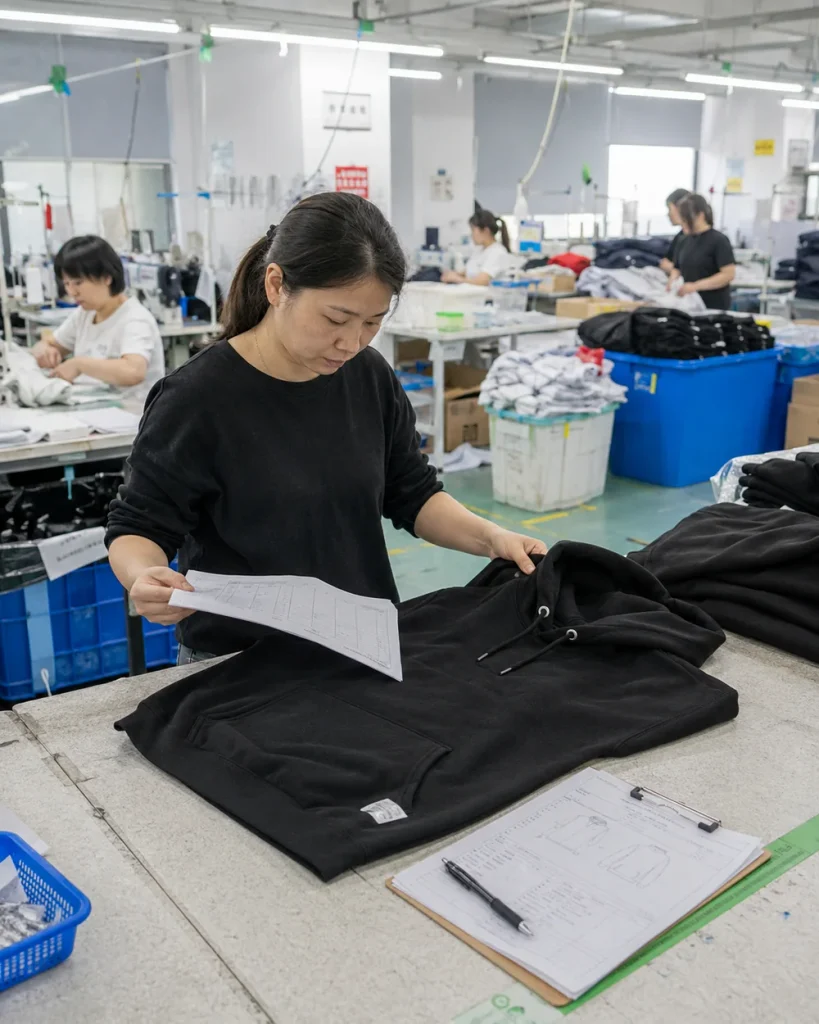
Packing
Labels, folding, polybags and other packing requirements are completed.
A washed hoodie or technical jacket may have a more complicated route than a basic T-shirt, but the principle is the same.
Bulk production works best when the product has already been clearly defined during development.
What I Would Send a Factory If I Had a Design Today
If I had a clothing design today and wanted to start manufacturing it, I would not wait until every technical detail was perfect.
I would try to make the first conversation useful.
I would send:
- Front and back design views
A sketch, digital drawing or clear product reference. - Reference images
Especially for fit, fabric or construction details. - Fit direction
Oversized, fitted, cropped, relaxed, structured or another clear description. - Basic measurements
If already available. - Fabric direction
Approximate composition, GSM, stretch and hand feel. - Artwork files
With the intended size and placement if known. - Colorways
Including which colors should actually be sampled. - Expected quantity per color
Not only the total order quantity. - Labels and packaging requirements
If already decided. - Any detail that must not change
You do not need every production question answered before contacting a factory.
The first conversation is part of development.
But the clearer the product is, the easier it becomes to source the right material, develop the pattern, make a useful sample and build a quotation that reflects the garment you actually want to produce.
If all you have today is a sketch, that can still be enough to start.
The next job is turning that sketch into something the factory can work with.
Send Your Design for Production Review
Have a sketch, reference garment or clothing design ready?
Send us what you have, together with your target quantity and any fabric or fit requirements already decided. We can review what is clear and what still needs to be developed before sampling begins.