12 Best Private Label Clothing Manufacturers for Startups in 2026
Finding the best private label clothing manufacturers is not really about finding the biggest factory. For a startup brand, the better question is whether a manufacturer can handle your current order size, develop the product correctly, and still support you when the order grows.
A brand testing 100 custom hoodies has very different needs from one ordering 5,000 technical jackets. MOQ matters, but so do pattern development, fabric sourcing, sampling, printing, quality control, communication, and the factory’s actual product experience.
For this 2026 guide, we compared 12 manufacturers with very different profiles. Some work with small startup brands, some focus on specific categories such as knitwear or outdoor clothing, and several are large manufacturing groups better suited to established brands.
The purpose is not to suggest that one factory fits every project. It is to make the differences easier to see before you start sampling.
Quick Comparison of the 12 Manufacturers
| Manufacturer | Location | Public MOQ | Main Strength | Best For |
|---|---|---|---|---|
| YX Custom Clothing | Dongguan, China | 100 pcs/color | Custom development + flexible OEM/ODM | Startup and growing brands |
| Billoomi Fashion | India | From 25 pcs/color | Very small custom runs | Early-stage brands |
| Laiwen Clothing | Dongguan, China | From 50 pcs/design | Womenswear and kidswear | Small fashion brands |
| Qianshiwear | Guangzhou, China | From 50 pcs/color/design | Streetwear and heavyweight apparel | Streetwear startups |
| The Evans Group | Los Angeles, USA | From 10 pcs/style | High-touch local development | Designers and premium brands |
| Create Fashion Brand | Portugal | 150 pcs/style/color full custom | Made-in-Portugal production | Premium European-positioned brands |
| KnitSeek | Hangzhou, China | 100 pcs/style | Dedicated knitwear manufacturing | Sweater and knitwear brands |
| Bowins Garment | China / Cambodia | Commonly 300–500 pcs/design | Technical outdoor apparel | Outdoor and functional brands |
| Dyon Fashion | China / Southeast Asia | Varies by program | Multi-location OEM/ODM | Growing brands |
| New Asia Garment | China | From 50 pcs on existing styles | Startup entry + large-scale capacity | Brands planning to scale |
| Esquel Group | China / Hong Kong | Not publicly stated | Vertical textile integration | Established international brands |
| Dewhirst | Global | Not publicly stated | Global retail manufacturing network | Large brands and retailers |
1. YX Custom Clothing — Best for Flexible Custom Development
Location: Dongguan, Guangdong, China
Main Products: T-shirts, hoodies, sweatshirts, jackets, tracksuits, dresses, pants and casual apparel
Services: OEM/ODM, private label, fabric and trim sourcing, sampling, printing, embroidery, labels, packaging and shipping support
MOQ: 100 pcs per color
Sample Lead Time: Usually 7–10 days
Bulk Production: Usually 10–20 days after sample approval
Best For: Startup brands, independent online sellers and growing apparel brands
YX Custom Clothing is aimed at brands that need more than a logo added to an existing blank.
A project can start from a tech pack, reference image, design file or existing garment. The development process covers material selection, sample development, fit review, printing or embroidery, private label details and bulk production.
This is particularly useful for startup brands working on custom T-shirts, hoodies and casual apparel, where fabric weight, fit, print method and finishing often matter as much as the garment itself.
YX also has access to techniques such as screen print, puff print, DTG and heat transfer, which makes it practical for brands developing graphic-heavy collections rather than basic undecorated garments.
Advantages: The development process is relatively straightforward for smaller brands, and fabric, branding, sample development and bulk production can be handled within the same workflow.
Limitations: YX is not primarily a technical protective-apparel factory. Brands developing highly engineered hunting, ski or industrial garments may need a more specialized supplier.

2. Billoomi Fashion — Best for Very Small Trial Orders
Location: India
Founded: 2005
Main Products: Womenswear, kidswear, woven garments, jersey garments and denim
Services: Pattern making, grading, fabric sourcing, sampling, printing, embroidery, labels, production, QC and logistics
MOQ: From 25 pcs per color for selected styles; custom print and embroidery normally require higher quantities
Sample Lead Time: Around 2–3 weeks
Bulk Production: Around 6–8 weeks
Best For: New brands trying to keep first-order inventory very small
Billoomi stands out because its published minimum is unusually low for full custom manufacturing.
The company accepts selected orders from 25 pieces per color, while printed and embroidered programs generally move to around 100 pieces. It also states production capacity of about 60,000 pieces per month.
That makes it worth considering for a founder who wants to test a product without holding several hundred units.
Advantages: Low entry quantity and a broad full-package workflow.
Limitations: A 25-piece MOQ does not apply to every fabric or decoration method. Complex prints, denim and custom material development can push the minimum higher.

3. Laiwen Clothing — Best for Small Womenswear and Kidswear Brands
Location: Dongguan, China
Main Products: Womenswear and kidswear
Services: OEM/ODM, pattern development, sampling, fabric sourcing and bulk manufacturing
MOQ: From 50 pcs per design
Sample Lead Time: Around 5–7 days for standard development
Best For: Small womenswear labels and children’s apparel startups
Laiwen takes a narrower approach than a general-purpose apparel manufacturer.
Its public positioning focuses on womenswear and kidswear, with low MOQ production and in-house sampling for startup and small brands. The factory states that standard samples can usually be developed in 5–7 days, with extra time for processes such as printing or embroidery.
For a new womenswear label, that category focus can be more useful than choosing a factory that produces ten unrelated product types.
Advantages: Low MOQ and a clear womenswear/kidswear specialization.
Limitations: It is less relevant for technical outerwear, heavy streetwear or specialist knitwear.

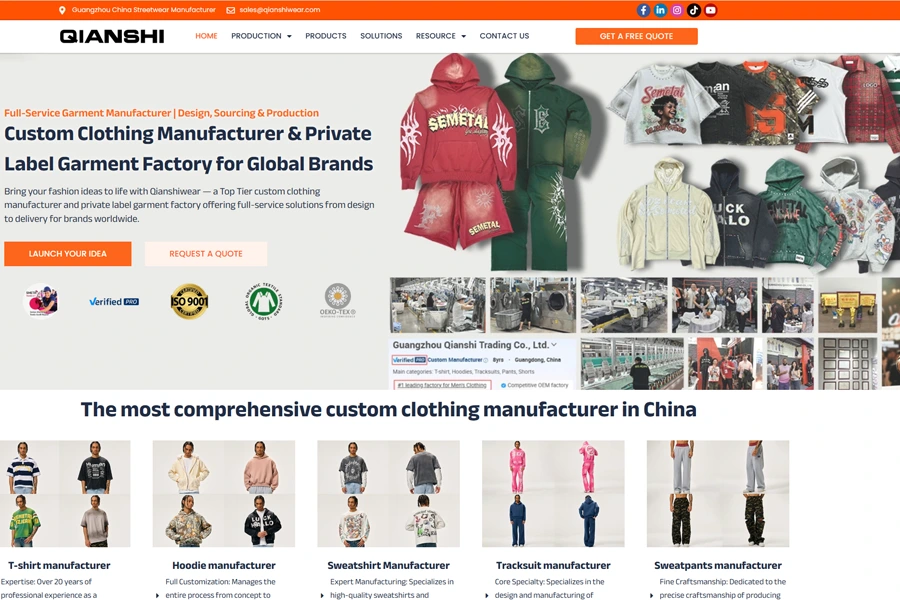
4. Qianshiwear — Best for Streetwear and Heavyweight Hoodies
Location: Guangzhou, Guangdong, China
Main Products: Heavyweight hoodies, T-shirts, sweatshirts and streetwear
Services: OEM/private label, custom fits, printing, embroidery, DTF, branding and packaging
MOQ: From 50 pcs per color/design
Sample Lead Time: Around 7–15 working days
Bulk Production: Around 20–35 working days on published programs
Best For: Streetwear labels and graphic-led collections
Qianshiwear makes more sense when viewed as a streetwear supplier rather than a general fashion factory.
Its product pages put a lot of attention on heavyweight fleece, oversized fits, washed finishes and decoration methods such as screen printing, embroidery and DTF. The current public MOQ starts at 50 pieces per color/design.
This matters because a 500–600 GSM hoodie has different construction and finishing requirements from a standard promotional sweatshirt.
Advantages: Stronger fit with heavyweight and graphic streetwear projects.
Limitations: Not the obvious choice for tailored womenswear, formal garments or fine-gauge sweaters.
5. The Evans Group (TEG) — Best for Small-Batch Made-in-LA Development
Location: Los Angeles, California, USA
Founded: 2005
Main Products: Contemporary fashion, designer apparel, couture and complex cut-and-sew garments
Services: Design, sourcing, patterns, samples, grading, cutting and production
MOQ: 10–50 pcs/style for studio production; factory production from 50 pcs/style
Lead Time: Studio production commonly 4–8 weeks
Best For: Independent designers and premium brands that want U.S.-based development
TEG follows a very different production model from a typical Asian export factory.
The company was formed in 2005 and works from Los Angeles, where it supports emerging and established designers through product development and small-volume manufacturing.
Its studio program can handle 10–50 pieces per style, while factory-level production begins at 50 pieces. That is useful for designers producing complicated garments or small capsule collections.
Advantages: Very small production quantities and close development support in Los Angeles.
Limitations: U.S. production sits at a different cost level from factory-

6. Create Fashion Brand — Best for Premium Made-in-Portugal Production
Location: Portugal
Production History: Stated since 1989
Main Products: T-shirts, hoodies, sweatshirts, pants, jackets, denim and premium basics
Services: Stock blanks, blank customization and full custom development
MOQ: No MOQ on selected stock blanks; 100 pcs/style/color for blank customization; full custom from 150 pcs/style/color
Best For: Premium casualwear and brands that want European production
Create Fashion Brand gives startups a useful middle ground between buying blanks and developing an entirely new garment.
A brand can start with existing premium blanks, add branding at a 100-piece level, or move into full custom development from 150 pieces per style/color.
The production is based in Portugal, which may be useful for brands where European manufacturing is part of the product positioning.
Advantages: Clear production routes and lower commitment when starting with blanks.
Limitations: Full custom quantities and development schedules are generally less aggressive than the fastest low MOQ Asian programs.
7. KnitSeek — Best for Custom Sweaters and Knitwear
Location: Hangzhou, China
Company History: Current company history states operations dating to 2002
Main Products: Sweaters, cardigans, knit dresses, knit tops and knitted accessories
Services: OEM/ODM, yarn sourcing, sample development and private label production
MOQ: 100 pcs per style
Sample Lead Time: 7–10 days
Bulk Production: 25–45 days
Best For: Knitwear labels and seasonal sweater collections
Sweaters should not be sourced in exactly the same way as fleece hoodies.
KnitSeek focuses on knitted garments and operates flat-knitting equipment across 3GG–18GG, including Stoll, Shima Seiki and Cixing machines. Its current factory information lists a 6,000-square-meter facility and output above 2.5 million units per year.
The 100-piece MOQ gives smaller brands access to genuine custom knitwear without starting at very large quantities.
Advantages: Dedicated yarn and knitwear knowledge rather than mixed-category production.
Limitations: The specialization is also the limitation: it is not a full-category cut-and-sew factory.

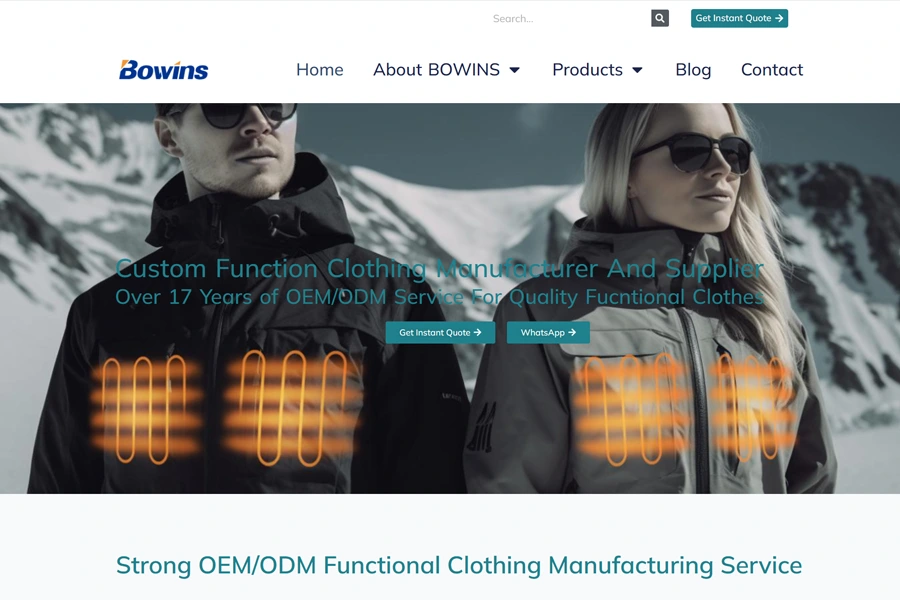
8. Bowins Garment — Best for Functional and Outdoor Apparel
Location: Shandong, China, with additional production in Cambodia
Founded: 2007
Main Products: Hunting clothing, ski wear, heated garments, motorcycle clothing and outdoor apparel
Services: Functional garment development and OEM/ODM production
MOQ: Common published programs are around 300–500 pcs per design
Lead Time: Often around 30–45 days depending on program
Best For: Outdoor and technical apparel brands
Bowins belongs in this list because technical apparel requires equipment and production knowledge that many casualwear factories do not have.
The company operates dedicated functional-garment production and lists categories such as hunting, heated clothing, ski apparel and motorcycle wear. Its current company information states production operations in China and Cambodia.
Published programs commonly show MOQs around 300–500 pieces, although some specialty products differ.
Advantages: Better suited to waterproof construction, technical fabrics and functional garment engineering.
Limitations: The MOQ and development process are less attractive for a
9. Dyon Fashion — Best for Brands Moving Into Mid-Scale OEM/ODM
Location: Ningbo, China, with additional manufacturing locations in China and Southeast Asia
Founded: 1998
Main Products: Womenswear, menswear, kidswear, woven and knitted apparel
Services: Design, sourcing, OEM/ODM, production and supply-chain management
MOQ: Varies by product and program
Best For: Growing brands that have moved beyond very small trial orders
Dyon is closer to a traditional manufacturing group than a low-MOQ startup workshop.
Founded in 1998, the company states that it has its own manufacturing operations in Ningbo, Anhui, Vietnam and Cambodia, supported by an internal R&D and design team.
Its published programs show that MOQ can vary substantially by garment and production location, so it is better to request a project-specific minimum rather than relying on one company-wide number.
Advantages: Broader production infrastructure and a better fit for brands building repeat volume.
Limitations: Early-stage brands testing several small styles may find more flexible suppliers easier to work with.

10. New Asia Garment — Best for Startups Planning to Scale
Location: China
Established: 1986
Main Products: Denim, T-shirts, hoodies, sweatpants, casualwear and fashion garments
Services: OEM/ODM, sample development, fabric sourcing, custom development and bulk production
MOQ: No MOQ for selected stock; existing style customization from 50 pcs; basic custom garments from 100 pcs/color; more complex development generally higher
Sample Lead Time: Commonly 5–10 days
Bulk Production: Commonly 15–30 days
Best For: Brands that want a small entry route with much larger capacity behind it
New Asia is one of the more interesting comparisons in this list because its scale does not automatically mean a very high starting MOQ.
The company publishes six specialized factories/sites, 12,000+ workers and annual capacity above 30 million pieces. At the same time, existing styles can be customized from 50 pieces, while T-shirts and hoodies start around 100 pieces per color.
Advantages: A startup can enter through a simpler product route and stay with the same manufacturing group as volume grows.
Limitations: Fully custom fashion products, denim and more complicated construction can require significantly higher minimums than basic apparel.

11. Esquel Group — Best as a Large-Scale Vertical Supply Chain Benchmark
Location: Hong Kong / China
Founded: 1978
Main Products: Textiles, shirts, knitted apparel and related products
Services: Textile development, spinning, weaving, knitting and garment manufacturing
MOQ: Not publicly stated
Lead Time: Not publicly stated
Best For: Established international apparel businesses
Esquel is included for perspective.
It is not being presented as the easiest factory for a founder ordering a first 100-piece collection. The group dates to 1978 and developed a vertically integrated textile and apparel supply chain spanning cotton, spinning, weaving, knitting and garment production.
For a mature brand, that level of vertical integration can be valuable. For an early startup, the lack of a publicly stated low-MOQ program means it should not be compared directly with a small-batch manufacturer.
Advantages: Deep textile and large-scale manufacturing capability.
Limitations: Public startup MOQ and lead-time terms are not available, so small brands should confirm whether their project fits the group’s sourcing model.

12. Dewhirst — Best for Large International Retail Programs
Location: UK headquarters with owned and partner manufacturing across Asia
Founded: 1880
Main Products: Menswear, womenswear and sportswear
Services: Design, sourcing, development, private label and manufacturing
MOQ: Not publicly stated
Lead Time: Not publicly stated
Best For: Established brands and large retail programs
Dewhirst sits at the other end of the market from low MOQ manufacturing.
Its history dates back to 1880. Today it has owned manufacturing in Bangladesh and Cambodia, with partner manufacturing in countries including Vietnam, Sri Lanka and India.
This type of network is useful for brands that already have predictable volume, sourcing teams and retail distribution.
Advantages: Multi-country manufacturing and experience with large international apparel programs.
Limitations: The company does not publish a startup-focused MOQ, making it less straightforward for very small first orders.

How We Selected These Clothing Manufacturers
We did not rank these companies only by factory size or advertised MOQ.
For startup brands, those numbers can be misleading. A 50-piece MOQ is of little use if the manufacturer cannot source your fabric, build your pattern correctly or repeat the same product six months later.
We looked at:
- Public MOQ information
- Product development support
- OEM/ODM and private label capabilities
- Sampling
- Fabric and trim sourcing
- Product specialization
- Production scale
- Manufacturing location
- Startup suitability
- Ability to scale with repeat orders
- Publicly available company and factory information
The ranking is therefore based mainly on fit for startup brands, not on which company is the largest manufacturer.
China vs. India vs. Portugal vs. USA: Which Is Better for a Startup?
There is no single best manufacturing country. The choice depends on your product and how your brand plans to sell it.
China
China is still particularly useful when a project combines custom fabric, trims, printing, embroidery, labels and packaging.
The supply chain is dense, and many suppliers can handle both development and bulk production. For startup brands ordering roughly 50–300 pieces per style or color, this flexibility can be useful.
India
India deserves attention for small quantities, womenswear, woven products, embroidery and detailed handwork.
Billoomi is a good example of how an Indian manufacturer can offer genuinely low entry MOQs while still handling custom development.
Portugal
Portugal is usually considered when the manufacturing origin itself is part of the brand positioning.
It works particularly well for premium jersey, organic cotton, streetwear and elevated basics, but the entry cost and development timeline may be higher than some Asian options.
United States
U.S. manufacturing makes sense when local communication and hands-on development matter more than achieving the lowest unit price.
A designer producing 20 complicated garments may get more value from a Los Angeles development house than from an overseas volume factory.
Southeast Asia
Vietnam, Cambodia and Bangladesh are important manufacturing bases for larger apparel programs.
They become particularly relevant when a growing brand needs volume, diversified sourcing or an alternative regional production base. Access to very small MOQs, however, depends heavily on the individual manufacturer.
How to Choose a Private Label Clothing Manufacturer
1. Ask What the MOQ Actually Means
Do not stop at “MOQ 100.”
Ask:
- 100 per style?
- 100 per color?
- 100 per fabric?
- Can sizes be mixed?
- Does printing have a separate minimum?
Four colors can turn a “100-piece MOQ” into a 400-piece purchase very quickly.
2. Separate Blank Customization From Full Custom Manufacturing
Putting embroidery on an existing hoodie is not the same as developing a hoodie from scratch.
For true custom apparel, check whether the supplier can handle:
- Pattern making
- Custom measurements
- Fabric sourcing
- Custom dyeing
- GSM requirements
- Rib and trims
- Print development
- Labels and packaging
This distinction alone eliminates a lot of unsuitable suppliers.
3. Use Sampling to Test the Factory
A sample is not only for checking how the garment looks.
Use it to verify:
- Fit
- Measurements
- Fabric hand feel
- Shrinkage
- Stitching
- Printing
- Embroidery
- Color
- Labels
- Finishing
If the sample still has unresolved issues, bulk production is too early.
4. Choose a Factory That Understands Your Product
A good T-shirt factory is not automatically a good knitwear factory.
A sweater requires yarn and gauge control. A ski jacket may require seam sealing and functional testing. A tailored dress has a different fitting and construction process again.
Specialization matters more as the product becomes more technical.
5. Ask for the Timeline in Separate Stages
Instead of asking, “How long is production?” ask for:
- Fabric sourcing
- Pattern development
- First sample
- Sample revision
- Material preparation
- Bulk production
- Printing or embroidery
- Final inspection
- Packing
You will get a much more realistic launch date.
FAQs
What is a good MOQ for a startup clothing brand?
For many custom apparel startups, somewhere around 50–150 pieces per style or color is a workable starting point.
That is not a universal rule. Custom-dyed fabric, special trims, denim washes, technical membranes and knitted yarns can all change the minimum.
What are the best private label clothing manufacturers for small brands?
The best choice depends on the product.
Billoomi is worth considering when keeping the first order extremely small is the main priority. TEG is a stronger fit for high-touch U.S. designer development. KnitSeek makes more sense for sweaters, while Bowins is much better aligned with functional outdoor apparel.
For startup brands developing custom casualwear, printed garments, hoodies and T-shirts through a China-based OEM/ODM workflow, YX Custom Clothing is one option to compare.
Can a startup work with a clothing manufacturer without a tech pack?
Yes, in some cases.
Several manufacturers can begin from reference photos, a sample garment or design sketches. A proper tech pack becomes increasingly useful as the product gets more complex because it reduces interpretation during sampling.
Is a low MOQ always better?
No.
A very low MOQ may reduce inventory risk, but it can also restrict fabric options, custom colors, printing methods or trims.
The better question is whether the MOQ still allows the factory to produce the product you actually want.
What information should I send for a clothing quotation?
What information should I send for a clothing quotation?
Send as much of the following as possible:
- Tech pack or reference photos
- Order quantity
- Number of colors
- Size range
- Fabric composition
- Fabric weight or GSM
- Print or embroidery artwork
- Labels
- Packaging
- Target delivery date
Clear specifications usually produce a more useful quotation.
How long does private label clothing production take?
There is no single standard.
Simple samples may be developed within a week, while complicated products can take several weeks. Bulk production may take roughly two to eight weeks or longer depending on fabric, quantity, workmanship and factory schedule.
Shipping time should be calculated separately.
Final Thoughts
The best private label clothing manufacturers in 2026 are not necessarily the factories with the lowest MOQ or the largest production floor.
A startup should first match the manufacturer to the product, order size and stage of the business.
If you are testing a very small collection, a 25–50-piece supplier may make sense. If you are developing premium knitwear or technical outdoor apparel, specialist equipment and product knowledge matter more. Once a brand reaches stable retail volume, larger groups such as New Asia, Esquel or Dewhirst become a different kind of option.
For custom T-shirts, hoodies, casualwear and private label collections, YX Custom Clothing works with brands from product development through bulk production, including fabric sourcing, sampling, printing, embroidery, labeling and packaging.
Ready to Start Your Clothing Project?
Send your tech pack, reference images, target quantity and customization requirements to YX Custom Clothing.
We can review the product, fabric, printing or embroidery, MOQ and production route before you move into sampling.
Request a Quote
Send Your Tech Pack
Discuss Your Custom Clothing Project
Ask About Sample Development
Related Resources
- How to Find a Clothing Manufacturer
- Custom Clothing Manufacturing Process
- Private Label Clothing Manufacturing
- Clothing Sampling Guide
- Clothing MOQ Guide
- Custom Printing and Embroidery
- About YX Custom Clothing