The approved sample looks right. Measurements have been confirmed, the fabric has been selected, and the print or embroidery position has already been signed off.
Then bulk production starts, and something changes.
Sleeves begin measuring shorter than the approved sample. A pocket sits slightly differently from one garment to another. One fabric lot looks darker under the same light. A print position that was correct on the sample starts drifting during production.
These are not all the same kind of problem.
Some garment defects are isolated mistakes that can be found and corrected during inspection. Others are signs that something in the production process is repeating incorrectly.
For a brand, the important question is not only how many defective garments are found.
It is whether the defect is random, where it started, and how early the production team can stop it from being repeated across the rest of the order.
1. When a Garment Defect Becomes a Production Problem
A single skipped stitch does not automatically mean the entire sewing process is out of control.Repeated garment defects usually point to a shared production condition rather than a single isolated mistake.
The same applies to one stain, one loose thread, or one damaged button. These may simply be isolated defects that need to be repaired or removed during inspection.
The situation changes when the same problem keeps appearing.
If twenty garments show the same sleeve-length direction, several pieces have identical seam puckering, or print placement continues moving in the same direction, the problem is no longer just one defective garment.
There is probably a production reason behind it.
That reason may be connected to the pattern, fabric, cutting, machine setting, measurement method, production instructions, washing process, or another shared condition.
This distinction matters because sorting out defective pieces does not correct the source of a repeated problem.
The number of defective pieces matters, but the pattern behind the defect matters more.

2. Why Bulk Production Can Differ From the Approved Sample
Brands sometimes assume that once a sample is approved, bulk production should simply reproduce it.
In practice, the approved sample is only one part of the production reference.
The production reference was not fully locked
A sample may have been approved after several revisions, but the latest changes still need to exist in the working production documents.
For example, the second sample may have a shorter sleeve, a heavier rib and a higher print position. If those changes only exist in emails or marked-up photographs while the measurement sheet or tech pack still shows the older version, the factory now has conflicting references.
Before production, the approved sample and the latest written specification should tell the same story.
This is also why revision control matters in a good clothing tech pack.
Bulk materials may behave differently from sample materials
Development samples are not always made from the final production fabric.
Even when the fiber composition looks the same, differences in weight, stretch, recovery, shrinkage or finishing can affect the finished garment.
A hoodie developed in one fleece may sit differently when bulk fabric has slightly different recovery. A jersey body may measure correctly before washing but react differently during finishing.
The garment pattern has not necessarily changed. The material conditions may have.
Production scale introduces new variables
Making one sample and producing hundreds of garments are different production environments.
Bulk production may involve more cutting layers, several operators, multiple machines, different fabric rolls and repeated finishing batches.
The objective of production control is to keep those variables within an acceptable range instead of assuming every garment will naturally come out identical.
The first serious check happens too late
Many garment defects are detectable much earlier than final inspection.
If the first thirty garments already show the same seam problem, allowing another five hundred pieces to continue before checking them only multiplies the correction work.
The timing of the quality check can matter as much as the inspection itself.
3. Measurement and Shape Defects
Measurement problems are often treated as if somebody simply measured the garment incorrectly.
Sometimes that is true. Often the cause starts earlier.
Typical problems include inconsistent body length, sleeve length outside the approved tolerance, unequal left and right sides, neckline variation, twisted garments or measurements changing after finishing.
Several production conditions can contribute:
- Fabric relaxation
- Cutting variation
- Sewing tension
- Stretching during handling
- Pressing
- Washing
- Different measurement methods
Consider a stretch garment.
If one operator lays the garment completely relaxed while another stretches the fabric slightly before measuring, both may record different numbers from the same piece.
The same problem can happen when a measurement method is not defined clearly enough.
But measurement variation can also be genuine. If finished body length keeps becoming shorter after washing, the team needs to investigate fabric shrinkage or finishing rather than repeatedly correcting the measurement report.
Measurement defects are not always created at the measurement table.
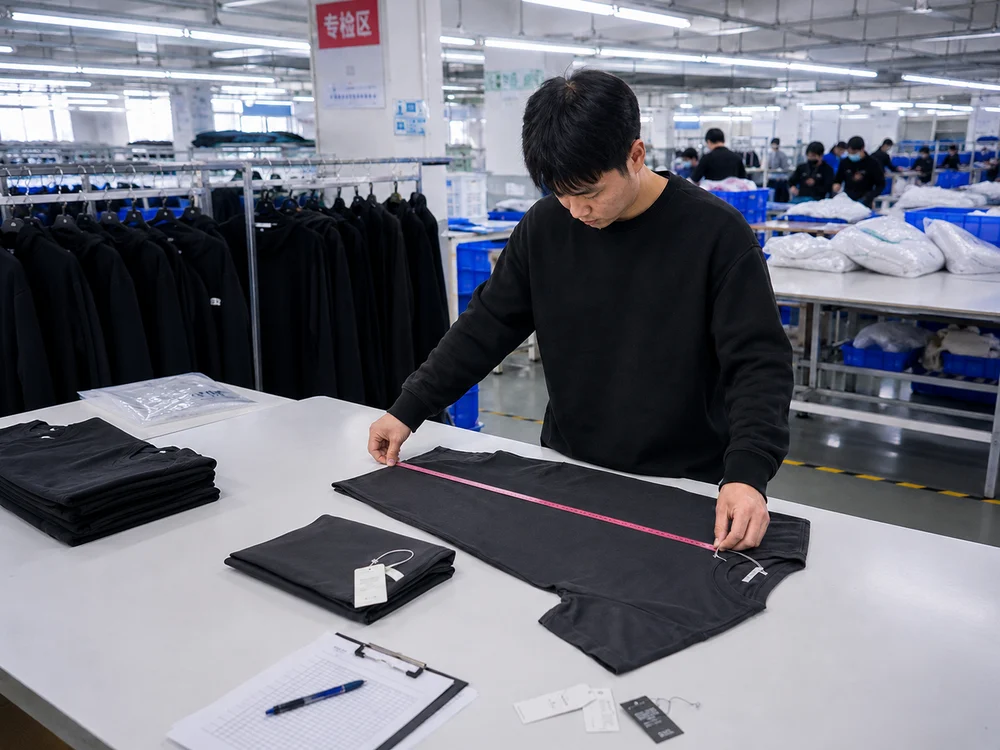
For bulk production, the useful approach is to monitor measurements during production and look for a trend.
One garment slightly above or below target may be different from a group of garments consistently moving in the same direction.
4. Sewing and Construction Defects
Sewing defects are some of the most visible problems in garment production, but the visible result does not always reveal the real cause.
Common examples include:
- Skipped or broken stitches
- Open seams
- Uneven topstitching
- Seam puckering
- Twisted seams
- Poor rib attachment
- Uneven pockets
- Mismatched panels
Take seam puckering as an example.
It is easy to look at a puckered seam and blame sewing workmanship. But similar puckering can result from thread tension, stitch density, feed settings, fabric behavior or how the operator handles the material.
The correction depends on the cause.
That is why inline checking should do more than separate good garments from bad garments.
If several pieces show the same problem, production should be checked while the process can still be adjusted.
The goal is not to wait until the entire order is completed and then discover that the same construction problem has been reproduced hundreds of times.
5. Trims and Component Problems
Small components can create surprisingly large production problems.
A garment may be sewn correctly but still fail the approved appearance or function because the wrong zipper, elastic, rib, label, button or drawcord has been used.
Typical issues include:
- Trim color not matching the approved reference
- Rib behaving differently from the body fabric
- Elastic with inconsistent stretch or recovery
- Incorrect label position
- Wrong button or snap
- Zipper performance problems
- Different trim versions mixed in the same production order
Some of these problems begin during sourcing rather than sewing.
A replacement component may look almost identical in a photograph but behave differently after it is attached to the garment.
For this reason, critical trims should be confirmed before they are distributed across production.
Finding the wrong component after hundreds of garments have already been assembled usually creates far more work than checking it at the incoming or pre-production stage.
6. Fabric and Shade Problems Before Cutting
Fabric problems deserve attention before cutting begins because many of them become much harder to correct later.
Possible issues include:
- Shade variation
- Fabric flaws
- Holes or surface damage
- Contamination
- Lot differences
- Inconsistent hand feel
- Different stretch or recovery
- Shrinkage variation
Shade control is a good example.
Two rolls may look similar individually but show a visible difference when panels from different rolls are sewn into the same garment.
If shade variation is identified before cutting, fabric can usually be separated and managed more carefully.
If different shades are mixed through cutting and sewing, the problem may only become obvious when finished garments are placed side by side.
At that stage, separating the affected panels is no longer simple.
Fabric problems become much more expensive once the fabric has already been cut.

The same principle applies to other fabric defects. A problem found before cutting affects fabric. The same problem found after sewing may affect completed garments, labor and delivery timing.
7. Cutting Problems That Only Become Obvious Later
Some defects that appear to be sewing problems actually begin in the cutting room.
Examples include:
- Inaccurate panel dimensions
- Incorrect grain direction
- Left and right panel differences
- Stripe or check mismatch
- Incorrect notch positions
- Variation between cutting layers
Imagine a sleeve that consistently twists after sewing.
The sewing operator may be the first person blamed, but if the panel was cut off grain or the pattern position was incorrect, sewing cannot fully correct it.
The same applies to pocket placement, panel symmetry and garment balance.
This is why checking cut components and first production pieces can be more useful than waiting for the final garment to reveal an earlier mistake.
A defect should be traced back to the stage where it was created, not simply the stage where it became visible.
8. Printing and Embroidery Defects
Decoration introduces another group of variables into bulk production.
Typical issues include:
- Print placement variation
- Incorrect finished artwork size
- Registration problems
- Poor adhesion or cracking
- Color variation
- Embroidery puckering
- Incorrect thread tension
- Unsuitable backing
An approved artwork file does not automatically mean the bulk decoration will be correct.
The actual garment size, placement reference, machine setup, curing conditions, embroidery backing and production positioning still need to match the approved sample.
Placement is particularly important.
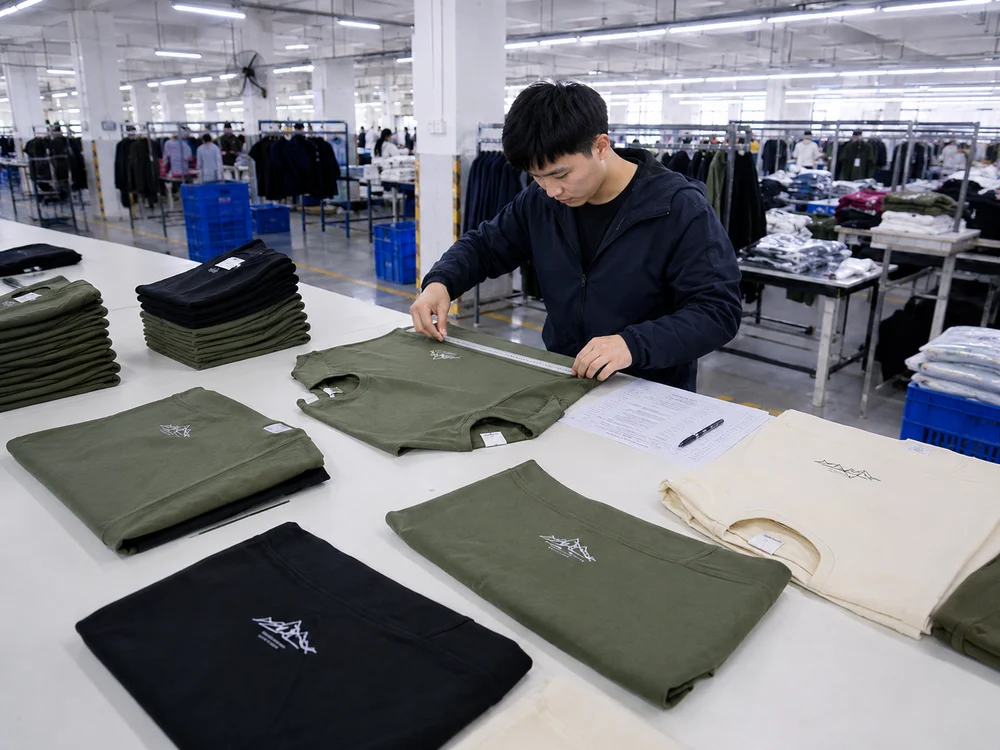
A few millimeters may not matter on some large graphics, while the same difference can be very noticeable on a small chest logo or embroidery positioned close to a seam.
For more detail on printing failures, see our guide to 10 Common Screen Printing Problems in Apparel.
9. Washing and Finishing Can Create New Defects
A garment can leave the sewing line looking correct and still change during finishing.
Depending on the product, later problems may include:
- Unexpected shrinkage
- Twisting
- Color change
- Uneven washing effects
- Pressing marks
- Shine
- Staining
- Shape distortion
This matters particularly when the garment uses washing, garment dyeing, stretch materials or fabrics that react noticeably to heat and moisture.
Suppose the sewing measurements are correct before washing but body length becomes consistently shorter afterward.
The useful question is not whether the sewing line measured correctly.
It is whether the production process accounted for what the garment would do during finishing.
Checking only before washing would miss the final condition the customer actually receives.
10. Why Inline Quality Checks Matter More Than Final Inspection Alone
Final inspection is important, but it should not carry the entire responsibility for quality control.
Different problems are best controlled at different stages.
Before production
The factory should confirm the working reference:
- Approved sample
- Latest specification
- Fabric and trims
- Artwork
- Measurement method
- Relevant production comments
This reduces the risk of producing the wrong version correctly.
During production
Inline checks can identify:
- Measurement trends
- Repeated sewing defects
- Shade problems
- Incorrect trim use
- Print placement drift
- Construction inconsistency
The important word is trend.
Finding one defective garment is quality checking.
Finding that the same defect is beginning to repeat and correcting the process before it spreads is production control.

Final inspection
Final inspection can then confirm the finished order for workmanship, measurements, appearance, quantity and packaging requirements.
Final inspection should confirm that production stayed under control. It should not be the first time serious production problems are discovered.
11. Why Some Defects Become Expensive to Fix
Not every defect creates the same correction problem.
Loose threads, some limited stitching issues or certain replaceable trims may be repairable without changing the garment itself.
Other problems can become difficult or expensive once production has moved too far.
Examples may include:
- Incorrect cutting
- Widespread shade variation
- Major shrinkage
- Incorrect garment proportions
- Serious washing problems
- Large-scale printing errors
The exact repair options depend on the garment and the severity of the issue, but the general pattern is clear.
The later a defect is discovered, the more production work may already depend on it.
A fabric issue found before cutting may require fabric replacement or segregation.
The same issue found after sewing may involve finished garments, labor, decoration, washing and packaging that have already been completed.
Early detection does not make every problem easy to solve, but it usually gives the production team more options.
12. How to Stop the Same Defect From Repeating
When a problem repeats, correcting individual garments is only part of the job.
The production team also needs to identify what is creating the repetition.
That may require checking whether the issue is connected to:
- One fabric lot
- One size
- One machine
- One production operation
- A cutting group
- A measurement method
- A finishing stage
- An outdated production instruction
Once a correction is made, the first corrected pieces should be checked again before full production continues.
The change also needs to reach the people actually producing the garment.
A correction written in an office message does little if the operator, cutting team or finishing team continues working from the old information.
Correcting one garment is not the same as correcting the production process.
Questions to Ask When a Defect Keeps Appearing
When the same problem appears repeatedly, these questions can help narrow down the source:
- Is the defect random, or does it always appear in the same area?
- Does it affect one size, color or fabric lot more than others?
- Are measurements moving consistently in one direction?
- Did the problem exist before washing, or only afterward?
- Was the approved sample made from the same fabric used in bulk?
- Did anything change in the machine, operator, setting or production method?
- Is the production floor using the latest approved revision?
- Could the problem have started during cutting rather than sewing?
The answers will not always identify the cause immediately, but they help separate an isolated defective piece from a process that needs correction.
Final Takeaway
Good garment quality control is not simply about finding bad pieces at the end of production.
The more useful goal is to recognize when a defect is beginning to repeat, trace it back to the stage where it started, and stop the same problem from being copied into the rest of the order.
An approved sample gives production a reference, but consistency still depends on fabric, cutting, sewing, decoration, finishing and inspection working from the same approved requirements.
For brands, that is often the difference between inspecting defects after they happen and controlling production while there is still time to correct them.
Discuss Your Production Requirements Before Bulk
If you already have a tech pack, approved sample or reference garment, send us the product details.
Our development and production team can review key construction, fabric, measurement and decoration requirements before sampling or bulk production, so the production reference is clear before the order moves forward.